Jump in the Fun, Love Every Mile



More than just a hike, the Everest Base Camp trek is a journey into the heart of Sherpa culture. Discover ancient monasteries, vibrant festivals, and the legendary hospitality of the Himalayas.
The alarm on my phone, a jarring, electronic beep, feels profoundly out of place. I fumble to silence it in the pre-dawn darkness of a teahouse in Dingboche. The air is thin and bitingly cold, a stark reminder that we are now at over 4,400 meters (14,400 feet). My body aches in a way that feels earned, each muscle a testament to the previous day’s climb through rhododendron forests and across glacier-fed rivers. But the discomfort fades the moment I pull back the thin cotton curtain.
There, framed by the frost on the windowpane, is Ama Dablam. The mountain, whose name means “Mother’s Jewelbox,” catches the first alpenglow, its icy peak blazing a fiery orange against the deep indigo of the receding night. For a moment, I can’t breathe, and it has nothing to do with the altitude. This is the postcard image, the one that launches a thousand trekking dreams. But what I’m learning, step by step, is that the true Everest Base Camp (EBC) trek is not just about this view. It’s about the people who live their entire lives in its shadow.
For many, the Everest Base Camp trek is a physical challenge, a bucket-list conquest to stand at the foot of the world’s highest mountain. And it is undoubtedly that. But to view it solely as a climb is to miss the point entirely. This legendary trail is a living, breathing cultural artery that beats through the heart of the Khumbu region. It is a pathway into the world of the Sherpa people, an indigenous community whose identity, spirituality, and legendary resilience are as much a part of the landscape as Everest itself .
This is the story of that other journey—the one that takes you not just to base camp, but into the soul of the Himalayas.
Before we put on our hiking boots, it’s essential to understand the ground beneath them. The term “Sherpa” is often incorrectly used as a job title for any mountain guide in Nepal. In reality, it is a specific ethnic group. The word Sherpa translates to “People from the East,” referring to their migration from the Kham region of eastern Tibet over the past 500 years . They crossed the high Himalayan passes and settled in the fertile valleys of Solu and Khumbu, bringing with them a rich tapestry of Tibetan Buddhism and a culture uniquely adapted to one of the most extreme environments on Earth.
For centuries, the Sherpas were subsistence farmers and traders. They herded yaks, grew potatoes (a crop introduced in the 19th century), and traversed the treacherous Nangpa La pass to trade barley and grains for Tibetan salt and wool . Theirs was a life of quiet isolation, deeply intertwined with the natural world and the spirits they believed inhabited it. This all changed in the 20th century when the outside world, in the form of British mountaineering expeditions, came knocking. The year was 1921, and the British were on their first reconnaissance of Mount Everest. They discovered that these “People from the East” possessed an almost superhuman stamina, a cheerful disposition, and an uncanny ability to navigate the high-altitude terrain. From that moment on, the Sherpa became an indispensable part of Himalayan climbing history, forging a legacy that continues to this day .
The journey begins, as it does for almost every trekker, with a flight into Tenzing-Hillary Airport in Lukla (2,845m). The flight itself is a rite of passage. The small plane buzzes through a corridor of valleys, the wings seemingly close enough to touch the lush green hillsides, before landing on a short, sloping runway that famously drops into a stone wall. It’s thrilling, chaotic, and a perfect metaphor for the adventure ahead.
As you take your first steps on the trail, you walk not just into the mountains, but into Sagarmatha National Park, a UNESCO World Heritage Site. The first day is a gentle introduction, a pleasant descent to the village of Phakding, where the trail follows the tumbling, turquoise waters of the Dudh Koshi (Milk River). You cross your first suspension bridges, heavy with prayer flags, and get your first taste of the teahouse culture that will be your home for the next two weeks .
The second day presents the first real challenge: the climb to Namche Bazaar (3,440m). The trail winds through pine and juniper forests, crisscrossing the river on increasingly high bridges. It’s a steep, unrelenting climb, but with every switchback, the views expand. And then, finally, you see it. Cradled in a giant horseshoe-shaped amphitheater of stone, Namche Bazaar appears like a shimmering mirage.
Namche is the unofficial “capital” of the Sherpa world. It is a bustling, colorful hub of activity, a place where centuries-old tradition meets the modern trekking industry. You’ll find internet cafes, bakeries serving apple pie, and gear shops stocked with everything from down jackets to trekking poles. But if you look closer, past the trekking crowds, you’ll see the real Namche. It’s in the Sherpa women in traditional aprons (pangi) bargaining in the market. It’s in the lines of colorful prayer flags strung between wooden homes. It’s in the distant, deep clang of a yak bell echoing off the hillsides.
Acclimatization in Namche is not just a physical necessity; it’s a cultural opportunity. On your rest day, take a short hike up to the Everest View Hotel. The slog up is worth it for your first unobstructed glimpse of Mount Everest, peeking over the shoulder of the mighty Lhotse-Nuptse ridge. But perhaps more rewarding is a detour to the nearby village of Khumjung. Here, you can visit the Khumjung Monastery, which famously houses what is purported to be a yeti scalp . More importantly, you can walk through a village where life continues as it has for generations, with potato fields and stone-walled farmhouses, offering a quieter, more authentic counterpoint to the commercial buzz of Namche.
Leaving Namche, the trail contours high above the Dudh Koshi, offering staggering views of the region’s most beloved peak, the iconic Ama Dablam. The vegetation begins to change; the tall pines give way to dwarf rhododendron and juniper. The air becomes thinner, crisper. And then, after a descent through a beautiful forest to a bridge over the raging river, you face the final climb of the day. It’s a steep one, but at the top lies one of the most spiritually significant places in the Himalayas: Tengboche.
Tengboche Village (3,860m) is dominated by its famous monastery, the largest in the Khumbu region . Originally built in 1916, the monastery was tragically destroyed by an earthquake in 1934 and again by a fire in 1989. Each time, it was painstakingly rebuilt by the Sherpa community, a testament to its central role in their lives . As you walk through the gates, the world seems to quieten. The flapping of prayer flags and the murmur of monks’ chants replace the sound of your own heavy breathing. The setting is almost impossibly beautiful, with the monastery set against a backdrop of Everest, Nuptse, Lhotse, and Ama Dablam .
For trekkers and mountaineers alike, a visit to Tengboche is a profound experience. It is customary to attend the morning puja (prayer ceremony) . Sitting in the dimly lit hall, surrounded by intricate murals of wrathful and peaceful deities, the air thick with the smell of butter lamps and juniper incense, you witness the living faith of the Sherpa people. The deep, guttural chanting and the rhythmic clang of cymbals are not just a performance for tourists; they are a daily ritual, a calling to the gods for protection and peace .
This is where you truly begin to understand the Sherpa relationship with the mountains. While we see them as a challenge to be conquered, the Sherpa see them as the home of the gods. Mount Everest itself is known as Chomolungma, which translates to “Goddess Mother of the World.” She is considered a generous but easily angered deity, Miyo Lang Zangma . For generations, climbing these peaks was considered blasphemous. While this has changed due to economic necessity and outside influence, the spiritual respect remains.
It is at monasteries like this that climbers and trekkers stop to receive a blessing before venturing higher. A lama will tie a small, plastic-covered amulet containing sacred mantras around your neck and offer a khata (a ceremonial white silk scarf). This simple act is deeply moving. As one monk at the 600-year-old Pangboche Monastery (a smaller, older gem further up the trail) explained to a writer from Outside Magazine, when people come for a blessing, they are “asking for forgiveness and safe passage on the peaks without incurring the goddesses’ wrath” . You carry this blessing, a tangible piece of Sherpa faith, with you for the rest of the journey, a silent comfort on the rocky trails ahead.
Above Tengboche, the landscape transforms. The forests thin out and are replaced by scrubland and alpine deserts. The trail passes through Pangboche, with its ancient monastery, and climbs to the windswept valley of Dingboche (4,410m). Here, the fields are enclosed by low stone walls to protect barley and potato crops from the biting winds. Another acclimatization day here offers the chance to climb Nangkartshang Peak, a nearby ridge that provides breathtaking views of Lhotse, the world’s fourth-highest mountain, and the vast Imja Tse valley .
The trek from Dingboche to Lobuche (4,910m) is a journey through a high-altitude moonscape. The path is rugged, following the terminal moraine of the Khumbu Glacier. Near the village of Duglha, you’ll pass a field of stone monuments, or chortens, erected in memory of Sherpas and climbers who have lost their lives on Mount Everest. It is a somber and humbling place. Fluttering prayer flags offer prayers to the departed, a poignant reminder of the ultimate price that has been paid in these mountains. It is impossible to pass by these stones without feeling a profound respect for the Sherpa climbers who navigate the deadly Khumbu Icefall year after year. Pemba Nurbu, the monk-caretaker at Pangboche, knows this reality intimately; he narrowly avoided death in the 2014 avalanche that killed 16 of his fellow Sherpas .
Standing there, in the thin, cold air, you realize that for the Sherpa, this isn’t just a career. It is a life lived in constant negotiation with the sacred and the dangerous. They climb, as Pemba Nurbu puts it, to eat and provide for their families, but they do so with a deep-seated knowledge that they are walking on the body of a goddess .
From Lobuche, it’s a final push to Gorakshep (5,164m) , the last stop before the ultimate goal. After a brief rest and lunch, you drop your bags and, with only a daypack, make the final journey across the Khumbu Glacier. The trail is a rocky, undulating path over the glacier’s lateral moraine. It’s a strange, almost otherworldly landscape of ice and rock. And then, after a few hours, you arrive. A flat expanse of ice and rock, littered with the colorful tents of climbing expeditions, surrounded by towering peaks.
Everest Base Camp (5,364m) itself is not the dramatic viewpoint many imagine. You cannot see the summit of Everest from here; it is hidden behind the massive Western Cwm and the Nuptse wall. But that doesn’t diminish the feeling. The sense of achievement is overwhelming. You are standing where legends have stood, at the foot of the world’s highest point. You can see the infamous Khumbu Icefall, a chaotic tumble of seracs and crevasses, the first great obstacle for those aiming for the top. For the Sherpa porters and guides moving through camp, it’s just another day at the office. For you, it’s a moment of personal victory.
But the true visual prize, the view that will forever be etched in your memory, comes the next morning. You wake long before sunrise, your water bottle frozen solid, your breath misting in the beam of your headlamp. You begin the slow, grueling, switchbacking climb up the black scree of Kala Patthar (5,545m / 18,192ft) . It is steep, exhausting, and at this altitude, every step is a conscious effort. You concentrate on the beam of light in front of you, on putting one foot in front of the other.
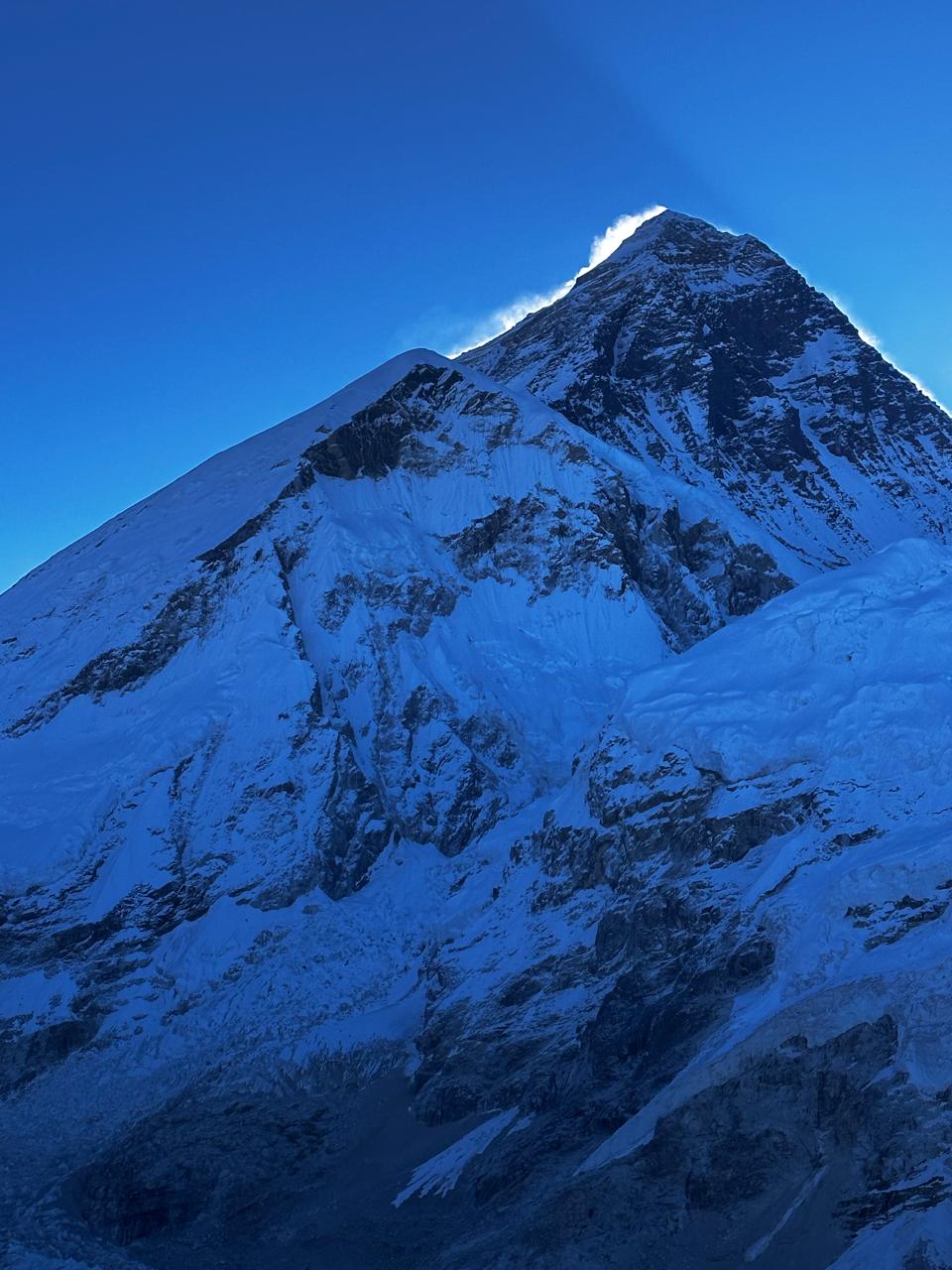
And then you reach the top. The sun begins to peek over the horizon. And as it does, it paints the world. The pyramidal summit of Everest, the sharp peak of Nuptse, the sheer face of Lhotse, and the elegant spire of Ama Dablam are set ablaze with golden light. The prayer flags strung across the summit snap violently in the frigid wind. You are surrounded by the highest peaks on Earth. In that moment, surrounded by strangers hugging and crying, you understand why you came. You feel the smallness of yourself and the immensity of the world .
The trek down is a revelation. What took days of struggle uphill is covered in a fraction of the time. The air gets thicker, the nights get warmer, and the landscape slowly greens. You pass through the villages you stayed in, but this time, you look at them with new eyes. You see the young Sherpa children walking to school, the elderly woman spinning prayer wheels, the teahouse owner who remembered your name and your tea order.
You realize that while you came to conquer a trail, you are leaving with something far more valuable: an understanding of a culture that doesn’t just live in the mountains, but with them. The Sherpa people have adapted their ancient faith and traditions to a modern world of trekking poles and satellite phones, all while maintaining an incredible warmth, resilience, and sense of community.
The Everest Base Camp trek is a physical challenge, yes. It will test your lungs, your legs, and your resolve. But its greatest reward is the cultural immersion. It is in the blessing at Tengboche, the butter tea in a family kitchen, the memorials at Duglha, and the smiling “Namaste” from a porter carrying twice his body weight. It is a journey to the roof of the world, but it is the heart of the Sherpa people that gives the trek its soul.
Ready to experience this for yourself? Here is a practical guide to help you plan your own Everest Base Camp trek.
The optimal times for the EBC trek are during the two main pre-monsoon and post-monsoon seasons .
Spring (March to May): This season offers moderate temperatures and the spectacular bloom of rhododendron forests, painting the lower trails in vibrant reds and pinks. The weather is generally stable, but the trails can be busy.
Autumn (September to November): Widely considered the absolute best time. The skies are crystal clear after the monsoon, offering unrivaled mountain views. The days are crisp and pleasant, making for perfect trekking conditions. This is also the season for the fascinating Mani Rimdu Festival, usually celebrated in October or November at Tengboche and other monasteries. This three-day event features masked dances, prayers, and ceremonies, offering a deep dive into Buddhist culture .
While itineraries vary, a well-paced trek including acclimatization days is crucial. Here is a common and effective outline :
You will need two main permits :
Sagarmatha National Park Entry Permit: Can be obtained in Kathmandu or at the park entrance in Monjo.
Khumbu Pasang Lhamu Rural Municipality Permit: (Often referred to as the TIMS card for this region). This is obtained in Kathmandu.
While the trail is well-trodden and it is possible to trek independently, hiring a local guide and porter through a reputable agency is highly recommended. A good guide is more than just a navigator; they are a cultural bridge. They can introduce you to teahouse owners, explain the significance of the mani stones you pass, and share stories that bring the landscape to life. Employing a porter also directly supports the local economy in a meaningful way . Look for companies that follow ethical practices, ensuring fair wages and good treatment for their staff.
If your schedule allows, timing your trek to coincide with the Mani Rimdu festival in Tengboche is an unforgettable experience. This sacred celebration, which typically lasts for three days, is a prayer for world peace and the well-being of all beings. The main events include the creation of a sand mandala, which is later ceremoniously destroyed to symbolize impermanence, and the famous masked dances (cham) performed by the monks. The monks don elaborate costumes and colorful wooden masks, portraying protective deities and historical figures, acting out the triumph of Buddhism over evil . It is a vibrant, colorful, and deeply spiritual event that offers an unparalleled glimpse into the heart of Sherpa Buddhism.
The Everest Base Camp trek is a journey on multiple levels. It’s a physical journey into the high mountains, a personal journey of challenge and achievement, and most importantly, a cultural journey into the heart of a community that has mastered the art of living at the top of the world. Go for the views, but return for the people. You won’t be disappointed.