Jump in the Fun, Love Every Mile



Imagine standing on a knife-edge ridge at 7,000 meters. The sun is rising, painting the Tibetan Plateau in shades of gold and crimson. To your left, the massive bulk of Manaslu (8,163m) pierces the jet stream. To your right, the entire Annapurna range stretches for a hundred miles. And beneath your feet? A mountain so remote, so pristine, that even today, only a few hundred people have ever stood where you are standing.
In the world of mountaineering, there are celebrities and there are hidden gems. Everest is the celebrity—crowded, famous, and outrageously expensive. But Himlung? Himlung is the secret that serious climbers whisper about. It is the mountain that offers the full Himalayan expedition experience without the traffic jams, the egos, or the circus.
But what actually is Himlung Himal? And more importantly, why are people from all over the world—from seasoned alpinists to ambitious first-timers—choosing to spend a month of their lives and thousands of dollars to climb it?
Grab a cup of tea, get comfortable, and let me take you on a journey to one of Nepal’s best-kept secrets. By the end of this article, you won’t just understand Himlung Himal—you’ll probably want to climb it yourself.
The Basics: A Mountain with an Identity
Let’s start with the hard facts, because every great mountain deserves a proper introduction.
Himlung Himal is a 7,126-meter (23,379-foot) peak located in the Peri Himal, a sub-range of the mighty Himalayas in north-central Nepal . If you look at a map, you’ll find it sitting right on the border with the Tibet Autonomous Region of China, approximately 28°46‘N latitude and 84°25’E longitude .
Here are the vital statistics in simple terms:
But numbers on a page don’t capture what this mountain really is. To understand Himlung, you have to understand where it sits.
Himlung is not one of those mountains you can see from the road. It doesn’t loom over a busy trekking route like Ama Dablam or Island Peak. To reach it, you have to go deep into one of Nepal’s most fascinating and historically restricted regions: the Nar Phu Valley.
This valley was only opened to trekkers in 2002 . Before that, it was a hidden Himalayan kingdom, culturally and ethnically Tibetan, isolated from the modern world for centuries. The approach to Himlung takes you through this valley, and honestly? For many climbers, the trek in is almost as good as the climb itself.
You start from the roadhead at Koto (2,600m), which is actually on the famous Annapurna Circuit. But instead of turning right with the crowds heading toward Thorong La, you turn left. You cross a suspension bridge, and within an hour, the tea houses thin out, the trail narrows, and you enter a different world .
The trail winds through dramatic gorges carved by glacial rivers, past ancient Buddhist monasteries with prayer flags snapping in the wind, and through villages like Phu Gaon (4,080m) —a settlement of flat-roofed stone houses that looks like it was transplanted directly from Tibet . The people here are of Tibetan origin. They speak their own language. They practice a form of Buddhism that has all but disappeared in other parts of the Himalayas.
This cultural immersion is part of the Himlung package. You don’t just climb a mountain; you journey through a living, breathing slice of Himalayan history.
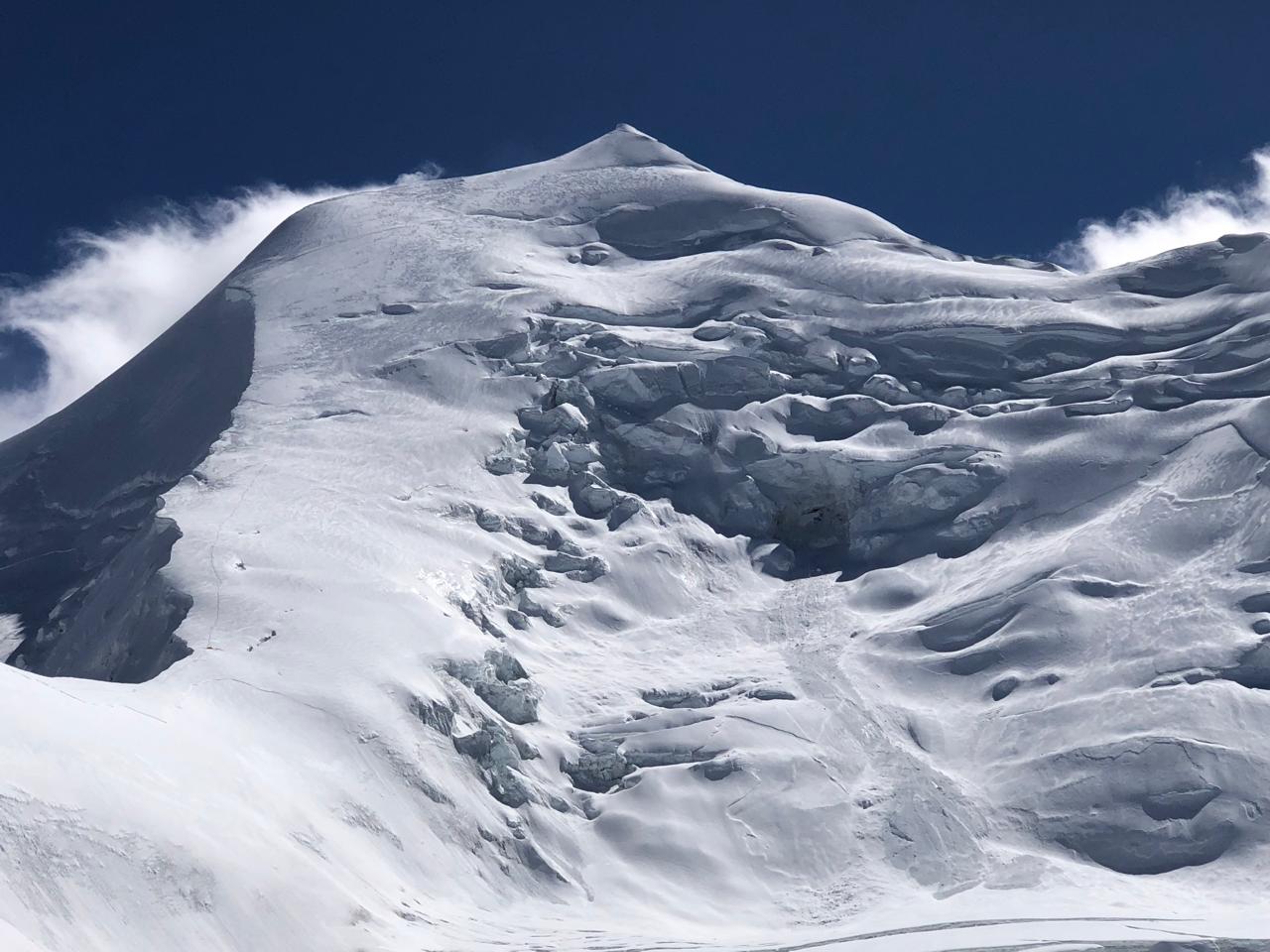
Himlung is not a sharp, technical “technical” peak like K2 or even Ama Dablam. It has a distinctive dome-shaped summit that rises from a long, elegant northwest ridge . From base camp, it looks imposing but achievable—a long sweep of snow and ice leading to a rounded top.
The mountain has three main faces:
The standard climbing route follows the Northwest Ridge, which is considered the most logical and safest way to the top .
Like many Himalayan peaks, Himlung’s early history is a bit murky. There is a record of a Japanese expedition claiming the first ascent in 1983 via the South Ridge and East Ridge . However, later climbers have cast doubt on this, suggesting that the 1983 team may have actually climbed the neighboring peak, Nemjung.
The universally accepted first ascent is credited to another Japanese expedition in 1992, led by Akio Tamura, who climbed the Northwest Ridge . This is the route that virtually everyone uses today.
For years after that first ascent, Himlung remained quiet. It wasn’t until the early 2000s, when Nepal officially opened the peak for climbing and the Nar Phu Valley was opened to tourism, that things started to change . Even then, the numbers remained small. As recently as 2013, when the UK-based company Adventure Peaks ran their first expedition, there had been only one recorded British ascent of the mountain .
Today, the numbers are still modest. In a given year, only about 77 to 90 climbers successfully summit Himlung . Compare that to Everest, where nearly 1,000 people can summit in a single morning, and you start to understand the appeal.
Okay, so we know what Himlung is. But why climb it? Why spend a month away from family, endure freezing temperatures, risk altitude sickness, and shell out thousands of dollars for this one particular mountain?
The answer is surprisingly complex. People climb Himlung for different reasons, but there are some powerful themes that emerge when you talk to those who have been there.
This is, by far, the most common reason climbers give for choosing Himlung. If you dream of climbing Everest, Lhotse, or K2, you cannot just show up and do it. You need to build a resume. You need to know how your body reacts at extreme altitude. You need to master the logistics of high-altitude camping, fixed rope travel, and glacier navigation.
Himlung is widely regarded as the ideal training ground for the 8,000-meter giants .
Think of it like this:
Himlung sits in that perfect sweet spot. It’s high enough that you experience the real challenges of the “Death Zone” threshold (above 7,000m, your body is literally dying). But it’s not so high that you require supplemental oxygen or multiple Sherpas to carry your gear.
As one expedition guide put it: “For anyone stepping toward 8,000-meter ambitions, Himlung builds confidence exactly where it matters most” .
Let’s be honest: not everyone is a rock star climber. Many of us are weekend warriors, fit and motivated, but not necessarily ready to tackle a vertical ice wall at 7,000 meters.
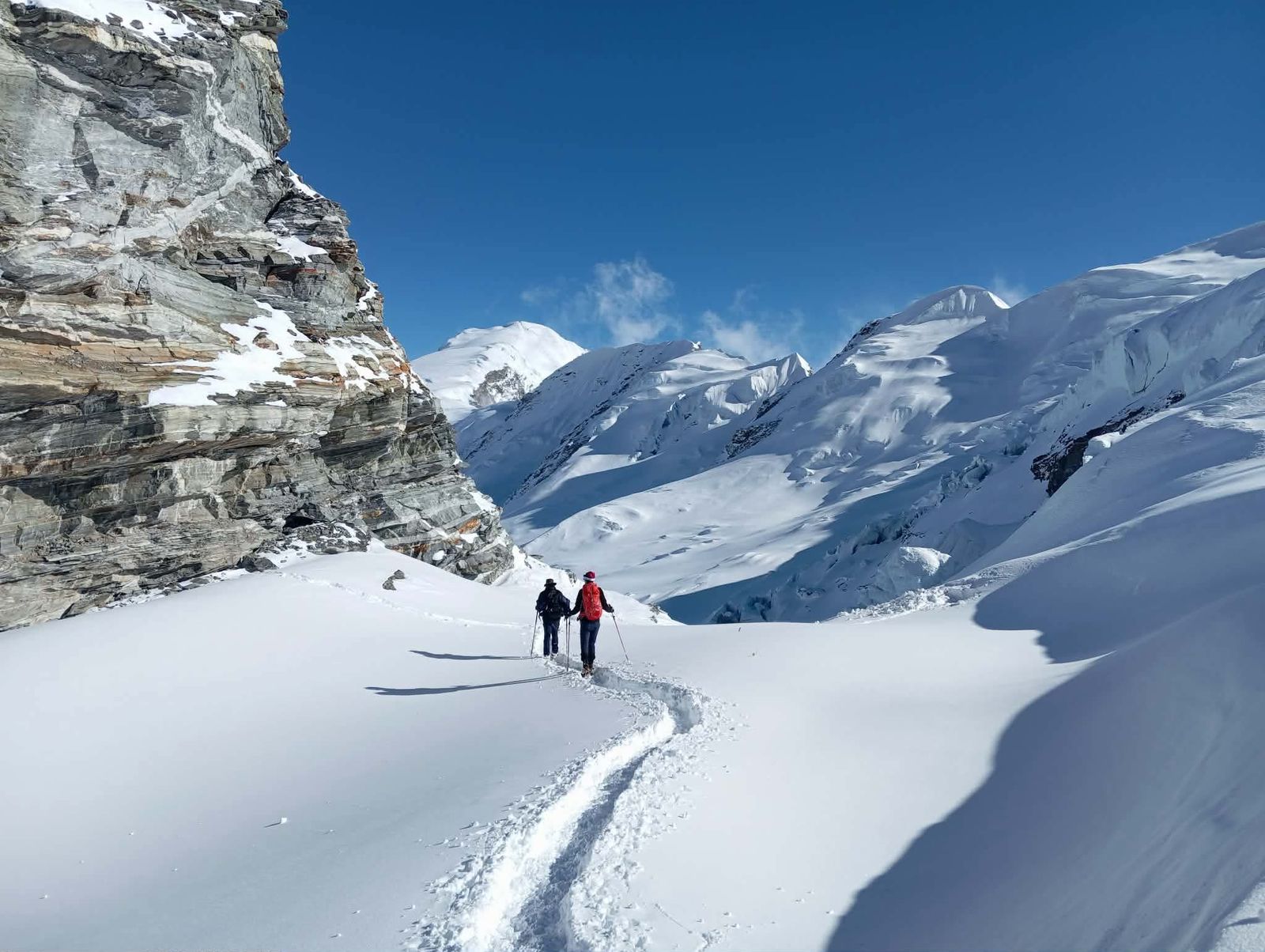
Himlung’s Northwest Ridge route is technically moderate, but it’s not a walk in the park. Here’s what you actually face on the mountain :
One detailed climbing report described the final section perfectly: “C3 to the summit is long and steep, with 600 meters of fixed rope. It starts with an exposed 30-degree snow slope, then hits the steepest section: a 400-meter, 35-degree slope. The risk of a slip is real” .
The takeaway? You need to be proficient with crampons, an ice axe, and jumars. You need to be comfortable on steep snow. But you don’t need to be a master ice climber.
This is the reason that tugs at the heartstrings of true adventurers.
In an age where Everest Base Camp looks like a festival grounds with yoga tents and latte bars, Himlung offers something increasingly rare: authentic wilderness .
One expedition leader described the feeling perfectly: “Himlung simply hasn’t developed the name recognition of peaks like Ama Dablam or even nearby Manaslu. The lack of publicity works in our favor—fewer climbers means more authentic experiences and less environmental impact” .
When you’re on Himlung, you are genuinely remote. The nearest road is a 5-7 day trek away. There are no helicopter tours buzzing your camp. There is no Wi-Fi at base camp (usually). There are no queues for the fixed ropes.
This remoteness filters the crowds. The people who make it to Himlung are there for the right reasons. They are serious about climbing. They have done their training. They respect the mountain. The camaraderie on these expeditions is often cited as a highlight, precisely because everyone is in the same boat—a small team, far from home, facing a big challenge together .
Climbers don’t admit it often, but a huge part of the motivation is the view from the top. And on Himlung, the view is absolutely world-class.
From the summit of Himlung, you are perched on the edge of the Tibetan Plateau. The world unfolds beneath you in a way that photos cannot capture .
One climber described the moment: “On the upper slopes of Dhaulagiri you can see hundreds of peaks in all directions, including the two other giants of the region. Himlung offers the same panoramic feast” .
Let’s face it: nobody wants to spend a month of their life and a small fortune to fail. While failure is always a possibility in the mountains (weather, illness, conditions), Himlung has a statistically favorable track record.
Experienced operators report success rates in the range of 75% to 90% for their Himlung expeditions . Adventure Peaks, a UK-based company, boasts that they have summited on every single one of their Himlung expeditions since 2013 .
Why is the success rate so high compared to other 7,000-meter peaks?
Of course, success is never guaranteed. The mountain demands respect, and every year, climbers turn back due to weather, altitude sickness, or personal reasons. But if you are well-prepared, Himlung offers some of the best odds in the high Himalayas.
I’ve touched on this, but it deserves its own section. The trek to Himlung Base Camp is not just a means to an end—it’s a core part of the experience.
The Nar Phu Valley trek is often described as a “Hidden Valley” trek. It combines the best elements of Himalayan travel :
One expedition operator notes: “The trek to Base Camp takes 5-7 days from the nearest road. That’s significantly longer than approaches to popular peaks like Island or Chulu East. This remoteness filters out climbers seeking convenient options” .
Let’s talk money, because it matters.
Is it cheap? No. But is it a fraction of the cost of an 8,000-meter expedition? Absolutely. For climbers building a resume, Himlung offers incredible value.
Now for the part you really want to know: what is it actually like to be there? I’ve compiled insights from climbers who have been on the mountain to give you a sensory, emotional picture of the Himlung experience.
The Good: The Beauty of Simplicity
One of the most striking things about a long expedition is how simple life becomes. Away from emails, news, social media, and the endless noise of modern life, your world shrinks to the essentials.
A seasoned expedition leader put it this way: “On an expedition it’s just sleep, eat, poo, repeat! The simplicity is beautiful. Your body is put under serious physical stress on a mountain, especially during a summit push, but your mind gets such a beautiful rest” .
This “beautiful rest” of the mind is something that many climbers don’t expect but end up cherishing most. You have hours to just sit and look at mountains. You have real, uninterrupted conversations with your teammates. You learn to find joy in simple things: a cup of hot tea, a pair of dry socks, a patch of sunshine.
Now for the honest truth: Himlung is a very, very cold mountain .
One climber, Jënni Jalonen, wrote a brutally honest account of her attempt on Himlung in October 2023. Her description of the cold is haunting:
“It had been so cold in the night and I had slept terribly. At 6 am I couldn’t take it anymore and sat up to melt snow on my gas stove—one bottle of hot water to put inside my sleeping bag and one cup of hot tea to drink. Hot water was one of the things I valued most on this expedition, as I spent almost every night (even in BC) freezing to the bones” .
At Base Camp (4,900m), daytime temperatures can be pleasant, reaching 15-20°C in the sun. But once the sun dips behind the ridge, the temperature plummets. At Camp 2 (6,000m) and Camp 3 (6,350m), night-time temperatures can drop to -20°C or even -30°C .
The cold is not just uncomfortable; it’s a safety hazard. It can freeze your stove fuel, making it impossible to melt water. It can give you frostbite if your gear fails. It can sap your will to continue.
Altitude sickness is the great equalizer on high mountains. It doesn’t care how fit you are or how much you’ve trained. It can strike anyone.
Jënni’s story takes a frightening turn on her summit push. After feeling relatively strong, she started to deteriorate rapidly at Camp 2:
“I was having a terrible headache and felt incredibly fatigued along with a lost appetite… The night was freezing cold… I’ve started having diarrhoea… I’m still having a headache and I’m feeling nauseous and a little unstable on my feet… Then, all of a sudden I start vomiting” .
These are classic symptoms of High Altitude Cerebral Edema (HACE) , a potentially fatal condition where the brain swells due to lack of oxygen. Fortunately, her teammate recognized the severity and immediately ordered a descent. “Only I am entirely incapable of packing my things, I don’t know what to pack and the effort feels extreme” .
This story has a good ending—she descended with help and survived—but it illustrates a crucial point. Himlung is safe and moderate compared to other peaks, but it is still a 7,000-meter mountain. It can and will kill you if you don’t respect it. The mantra of every safe climber is: “The summit is optional, but the descent is mandatory.”
So why endure the cold, the risk, the discomfort?
For the moment when you top out.
Imagine this: You’ve been climbing for 6 to 8 hours from High Camp. It’s been dark most of the way, your world limited to the beam of your headlamp. You’re exhausted, running on pure willpower and sips of frozen water. Your Sherpa guide, moving with practiced ease, keeps the rope taut between you.
Then, the angle eases. The ridge broadens. And suddenly, you are there. The summit of Himlung Himal.
There is no “top” in the sense of a single point—the summit is a broad, domed crest . You walk those last few steps, and the world opens up. The sun is up now, warming your frozen face. You see the curve of the earth. You see Tibet. You see mountains that have no names.
One climber described the feeling as a mix of “exhaustion, joy, and profound gratitude.” You hug your guide. You take the obligatory photos. And for 15 or 20 minutes, you are the highest person for miles in any direction.
Then, you turn around and start the long, careful descent. But you are changed. You have done something that most humans will never do. You have stood on the roof of the world.
If you’ve read this far, there’s a good chance you’re considering climbing Himlung yourself. Here is a straightforward checklist of what you need to do to turn that dream into reality.
Step 1: Build Your Foundation (12-6 Months Out)
A typical 30-day itinerary looks like this :
Days Activity
Finally, prepare your mind. Read accounts like Jënni’s to understand the real challenges . Talk to your operator about what to expect. As one guide wisely said:
“Everyone draws their motivation and their strength from different places. For me, it comes from being confident in one’s ability to reach the summit. This confidence comes from the training you complete and your previous experience… Combining that confidence with the understanding that weather or other factors outside your control may result in you not being able to summit results in a very powerful combination” .
So, let’s bring it all together.
Himlung Himal is a 7,126-meter peak in a remote corner of Nepal, offering a perfect blend of challenge, culture, and wilderness. It is technically moderate but physically demanding, cold but beautiful, remote but accessible.
People climb Himlung because:
But if you want a guided walk-up with hotels and Wi-Fi and zero risk? Look elsewhere. Himlung is a real mountain. It demands respect, preparation, and a willingness to suffer a little for something beautiful.
And for those who answer that call? The reward is a memory that will last a lifetime. A memory of a dome-shaped peak on the edge of Tibet, of frozen nights and brilliant sunrises, and of the quiet satisfaction of knowing you climbed your own mountain.
Have you climbed Himlung Himal? Are you planning an expedition? I’d love to hear your questions and stories in the comments below. If you found this guide helpful, please share it with fellow adventurers who might be dreaming of the high Himalayas.